Bharadwaj Amrutur*, Navakanta Bhat*, Himanshu Tyagi*, Aditya Gopalan*, Chandra Shekhar P.*, Sridhar S.*, Rakshit Ramesh*,
Vijay Mishra*, Mahesh Kashyap* Ajay Agrawal#, Suhas Bose# E S Kim$, Bhaskar Krishnamachari$, and George Ban-Weiss$,
*Indian Institute of Science, Bangalore, India; #Central Electronics Engineering Research Institute, Pilani, India; $University of Southern California, Los Angeles, U.S.A.
Air Pollution in Indian cities has emerged as a very serious public health problem. Low-cost sensor devices along with the calibration techniques will have the potential to revolutionize air quality monitoring.
 A
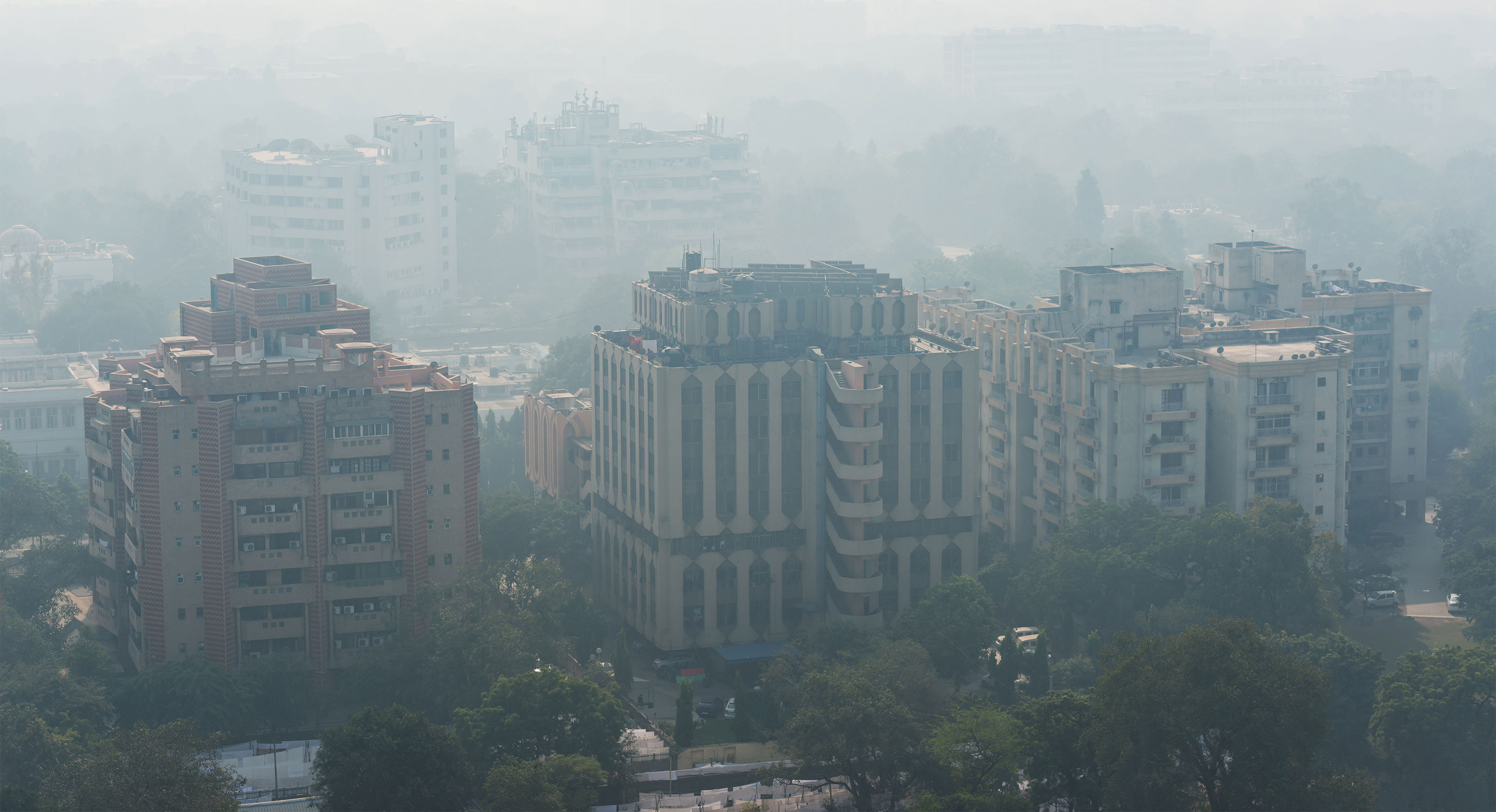
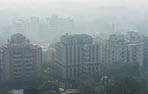
A recent WHO study identified that India is home to 14 of the 15 most polluted cities in the world. Sources of air pollution in India range from vehicle emissions and traffic congestion to biomass and fuelwood burning. Poor air quality has serious health impact not just for vulnerable sections (children and the elderly), but also for otherwise healthy adults. Outdoor air pollution has been identified to be the fifth biggest killer in India and has been implicated in respiratory and cardiovascular diseases as well as asthma, bronchitis, lung-cancer, acidosis etc. Carbon Monoxide (CO) can cause harmful health effects by reducing oxygen delivery to the body’s organs and can be fatal at high concentrations. Sulphur Dioxide (SO
2) can cause respiratory illnesses while short term Nitrogen Oxide (NO) exposures may cause airway inflammation and increase respiratory symptoms in people with asthma. Children are at great risk from exposure to Ozone as they are more likely to be active outdoors when Ozone levels are high.
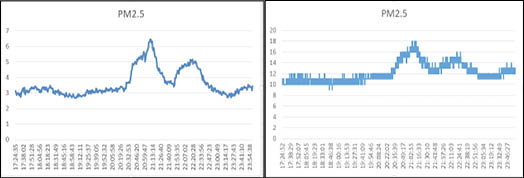 Fig. 1 : Left panel shows data from an expensive, higher quality sensor, while the right panel is data from a low cost sensor. Notice the disparity in the readings for PM2.5 concentration
The first step towards mitigating air pollution is to reliably measure the amount of pollutants in air at a given location. Air quality index (AQI) is the measure of how good or bad the quality of air is over a region and is calculated based on measured concentrations of 8 different pollutants including CO, SO
2 and particulate matter (PM) of size upto 2.5µm and 10µm in diameter. In India, an AQI between 0-100 is considered to be safe while an AQI above 200 is considered harmful for humans. Concentration of pollutants are typically measured at a few monitoring stations using expensive reference grade equipment whose cost can run up to one Crore rupees. Many manufacturers have recently come out with lower cost equipment, with reasonable quality, but these too can cost up to seven lakh rupees. Thus it is impractical to deploy many such monitoring equipment and hence the pollution data we currently get is very sparse at kilometres level granularity. In this context, developing low-cost sensors that can reliably measure the concentration of the pollutants and can be deployed in large numbers at even 100s of meter spacing becomes important
1. However low-cost sensors have a problem in terms of the quality of data they produce as can be seen in data from two sensors in Fig. 1, with the right panel from a low cost sensor. Thus if one wants to successfully use low cost sensors, it is critical to address this quality disparity issue.
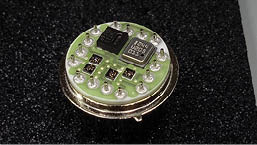 Fig 2 : Metal-Oxide gas sensors developed at IISc.
Scientists from Indian Institute of Science, Bangalore (IISc), in collaboration with the Central Electronics Engineering Research Institute, Pilani (CEERI) and University of Southern California (USC), are currently working on a project funded by Indo-U.S. Science and Technology Forum (IUSSTF) to address this specific issue of quality of low-cost air quality sensors. The Center for Nano Science and Engineering at IISc Bangalore has developed low- cost, metal oxide based gas sensors
2.
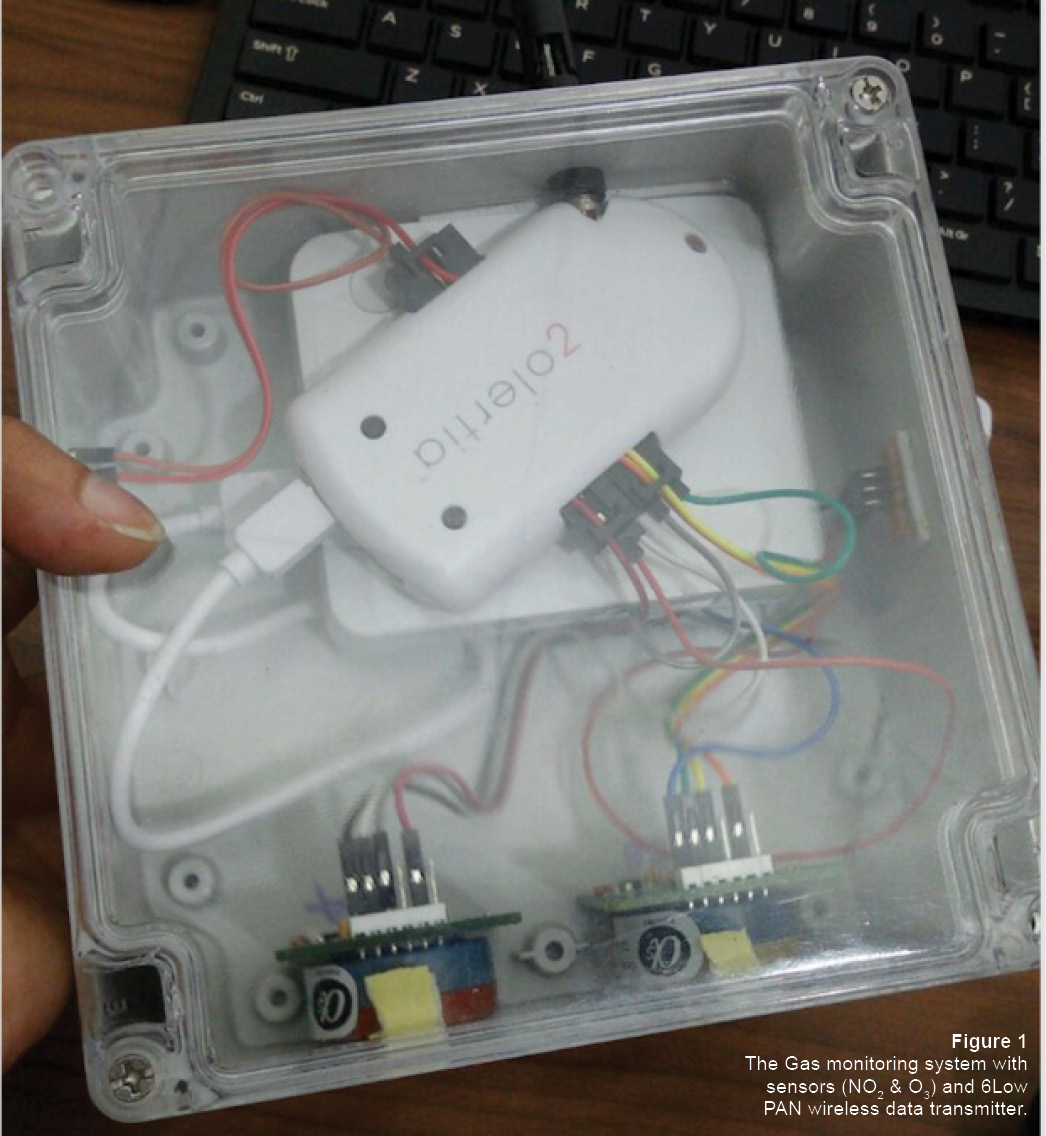
The semiconductor-like, mass fabrication process to manufacture these, enable low production costs. A similar process is used by CEERI to develop Volatile Organic Compounds (VOC) sensors. The Robert Bosch Center for Cyber-Physical Systems at IISc will be deploying these sensors, along with a few commercially available sensors (such as Bosch’s CLIMO) both at IISc and at the Smart-City testbed at the Electronics City, Bengaluru. The air quality data will be collected via the middleware framework developed by the Robert Bosch Center at IISc
3 and will be used for data analytics and modelling studies. Colleagues from the Electrical Communication Engineering department at IISc, will analyse this data and develop algorithms for both estimating the quality of the data, as well as techniques to correct the data (or calibrate the sensor readings). A combination of data-driven machine learning approach along with traditional dispersion based physical models for air quality will be used to explore possible solutions.
These low-cost sensor devices, along with the calibration techniques, will have the potential to revolutionize air quality monitoring and can be used to develop detailed spatiotemporal maps of pollutants. Such maps can be potentially used to determine the exposure to pollution for each individual. For example, given a route taken by a person to their work-place, the total exposure for the person during travel can be determined, thereby providing the person with a choice of taking an alternate less-polluted route
4. Knowing air quality reliably has implications for not only public health, but also urban traffic.
- Kumar, Prashant, et al. "The rise of low-cost sensing for managing air pollution in cities." Environment international 75 (2015): 199-205.
- Prajapati, Chandra Shekhar, et al. “Single Chip Gas Sensor Array for Air Quality Monitoring.” Journal of Microelectromechanical Systems 26.2 (2017): 433-439.
- Amrutur, Bharadwaj, et al. “An open smart city IoT test bed: street light poles as smart city spines.” Proceedings of the Second International Conference on Internet-of-Things Design and Implementation.
- Skjetne, Erik, and Hai-Ying Liu. “Traffic Maps and Smartphone Trajectories to Model Air Pollution, Exposure and Health Impact.” Journal of Environmental Protection 8.11 (2017): 1372. ACM, 2017.




 For a Breath of Fresh Air