S.N. Tripathi*, Jishnu Bhattacharya*, Rajesh Zele# , Yogesh Simmham$, Malati Hegde$, Mike Bergin^, Ronak Sutari~
*IIT Kanpur, INDIA, #IIT Bombay, INDIA, $IISc Bangalore, INDIA, ^Duke University, U.S.A., ~Urban Sciences, Mumbai, INDIA
Air pollution, both outdoors and in households, is ranked as the second-most serious risk factor for public health in India after malnutrition, according to a report (2017) by Indian Council of Medical Research, Public Health Foundation of India, and Institute for Health Metrics and Evaluation.
 A
A t this time, the influences of different sources of air pollution on human health are not well understood, given the lack of knowledge of air pollutant concentrations across India. To address this, a large, multi-institutional project on
Air Quality Monitoring Streaming Analytics on Temporal Variables from Air Quality Monitoring (SATVAM) with IIT-Bombay and IISc as collaborating institutes from India and Duke University from the U.S. has been recently funded by the Indo-U.S. Science and Technology Forum. A system like SATVAM that we propose, can collect this information nation-wide sustainably and at a low-cost and will allow policy makers and citizens at large to deploy data-driven control and preventive mechanisms.
The key objective of this project is to scale air quality monitoring by developing low-cost, energy self-sufficient air quality sensors that can be calibrated on the fly to transmit data seamlessly via cloud servers.
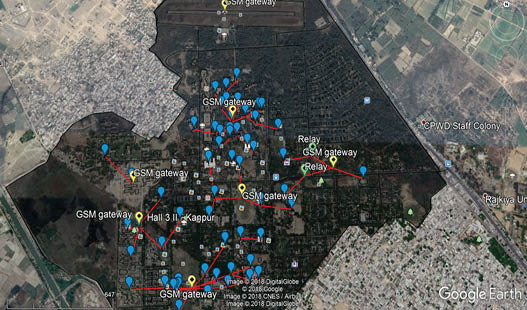 Figure 2: Geospatial view of draft deployment plan of motes and air quality sensors in IIT-K based Sub-GHz mote platform
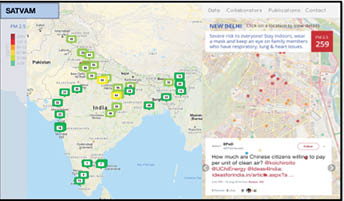 SATVAM : Nationwide Real-time
Air Quality Outlook
SATVAM : Nationwide Real-time
Air Quality Outlook
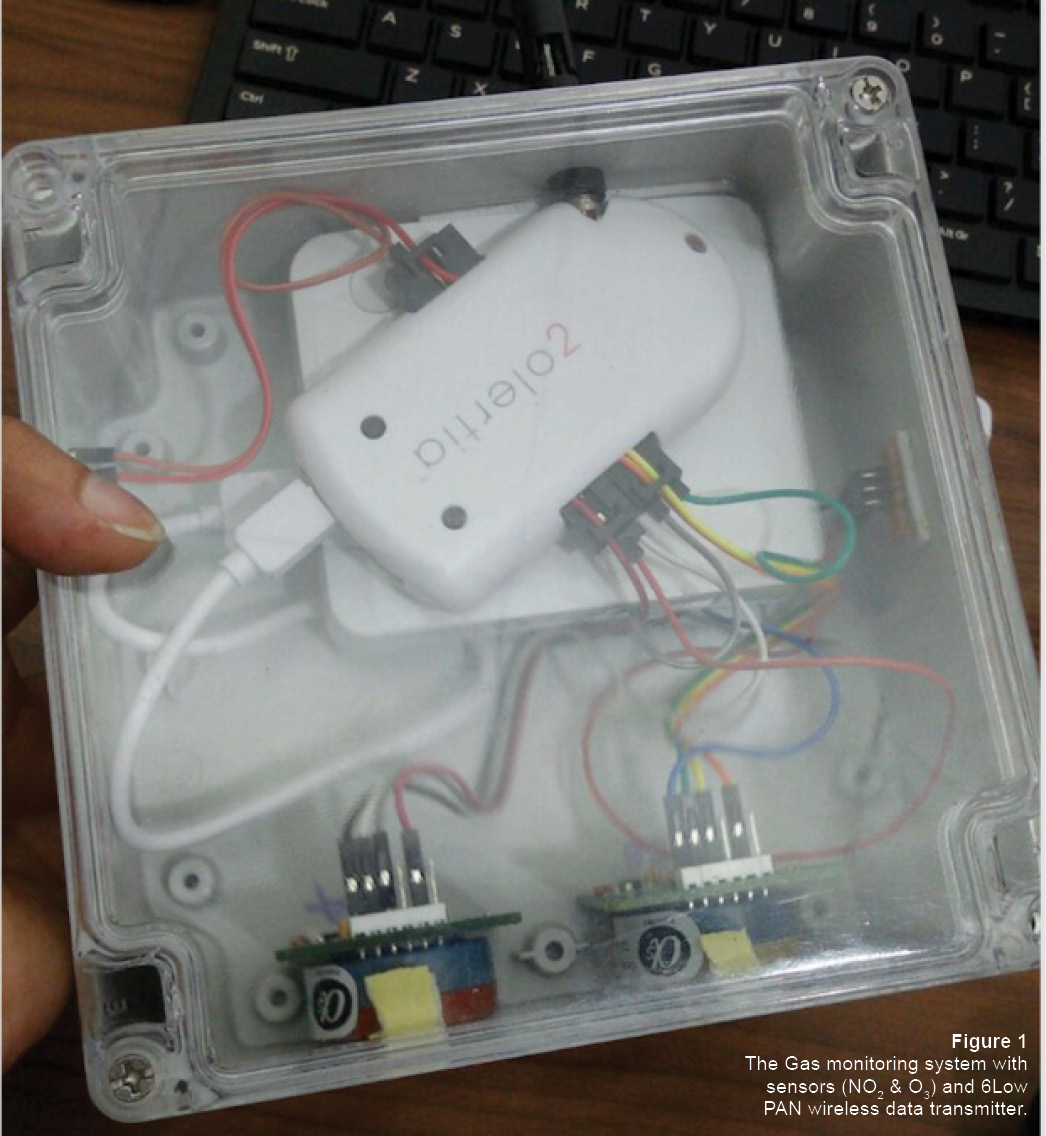
The SATVAM Gas monitoring system uses the Alphasense NO
2 & O
3 sensors which are connected to a System on Chip (SoC) module built using the TI CC2538 ARM Cortex-M3 running the ContikiOS. The module is configured to transmit over the 6LowPAN protocol stack.
The system we propose will provide long-range wireless data loggers which are energy self-sufficient using solar harvesting followed by energy storage such that uninterrupted monitoring of air pollutants is ensured in the remotest areas where either power lines have not reached, or scarce, or still face long power outages. Novel technique such as Thermoelectric Generation will be used to enhance the overall efficiency of the energy conversion. Initial results obtained thus far have been very encouraging.






 Analysing Air Quality