Coastal aquifers are susceptible to degradation due to its proximity to seawater, higher population, climatic influences and human intervenes. For coastal aquifers to continue being used as operational freshwater reservoirs, the development of better tools that facilitate the prediction of aquifer behaviour under climate change conditions and human interference is essential. This Indo-U.S. Workshop on
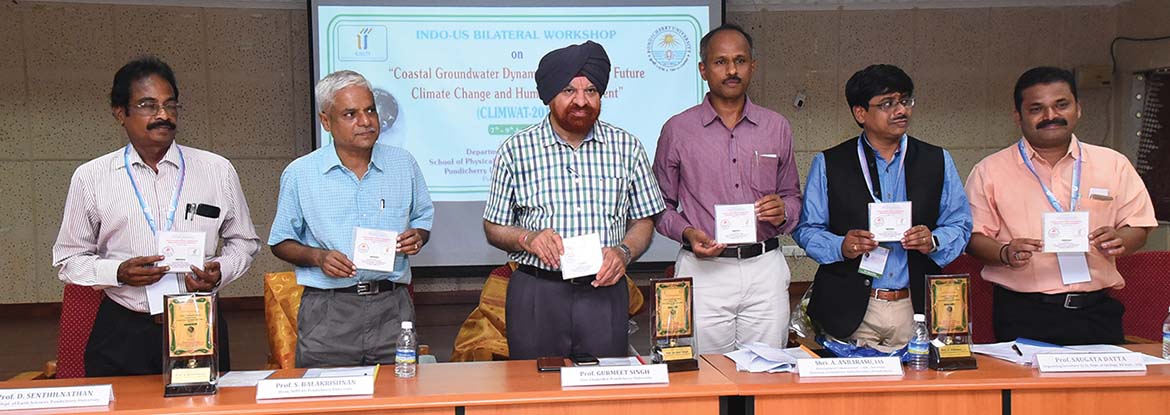
Coastal Groundwater Dynamics: Combining Future Climate Change and Human Development (CLIMWAT-2018) organized by
K. Srinivasamoorthy (Pondicherry University, Puducherry) and
Saugata Dutta (Kansas State University, Manhattan) aimed to discuss and explore areas for advancing scientific understanding of groundwater and future climate change scenarios. It brought together researchers and practitioners from Indian and U.S. universities/organizations to provide a platform for the exchange of knowledge and experiences in combating coastal groundwater dynamics relating to future climate change and human influences using integrated techniques in specialized areas such as Technologies for vertical electrical tomography in assessing coastal vulnerability; Combined hydrochemistry, Isotopes and REEs in isolating coastal dynamics, past and present climatic influences; Application of flow, transport and geochemical modeling for coastal groundwater; Neural networks, multivariate statistical modeling for sea water intrusion and water quality parameters; Biogeochemistry of aquatic ecosystems, adaptability of biota to climate change, exposure to contaminants; and, Remote sensing and GIS techniques for coastal groundwater resource management, climate change resilience and protection scenarios.
5th Bangalore Cognition Workshop
17-29 June 2018
Bengaluru, INDIA
Cognitive neuroscience research in India has roots in studies of head-injury and neurosurgical patients in the 1950s. This tradition of clinical research continues, but over time it has become augmented by basic cellular and systems level research in neuroscience, as well as by the development of non-clinical programs in neuroscience education. The
5th Bangalore Cognition Workshop organized by
Balaji Jayaprakash (Indian Institute of Science, Bangalore) and
Thomas D. Albright (Salk Institute for Biological Studies, La Jolla) represented a continuation of efforts to build human resource development in the country in Cognitive Sciences. It was conducted through four modules which were aimed at providing a focused introduction to the problems and concepts in various aspects of neuroscience. These modules were: Vision, Attention – Multiple Scales, Motor Systems and, Memory and Spatial Navigation. The workshop introduced distinguished researchers with expertise in nearly every aspect of neuroscience to the participants. The goal of the workshop was to inspire Indian students to pursue a career in neuroscience while providing a mechanism to facilitate scientific exchanges between India and the United States.
3D Printing: A Solution for Medical Devices
17 August 2018
Thanjavur, INDIA
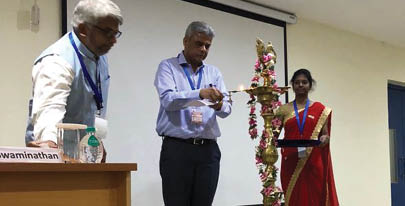
Developing biomedical implants and devices have a huge demand in the medical industry as it extends the essential function of human organs thereby improving the quality of patient lives. However, designing distinct types of medical implants or devices demands specific sets of requirements in terms of dimension, architecture and material selection since the application of these biomedical implants may vary based on the implantation site.
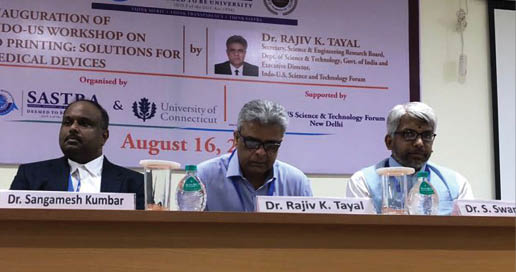
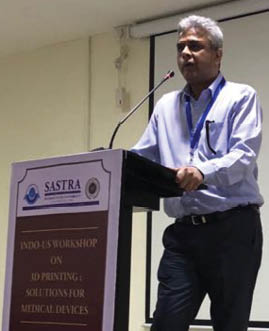
Emergence of 3D printing technology in the healthcare sector enables the rapid customization of implants with high precision and enables new product developments right from the anatomical models, mass production of patient-specific implants to personalized surgery. The main concept of this joint workshop on
3D Printing: A Solution for Medical Devices organized by
S. Swaminathan (SASTRA University, Thanjavur) and
Sangamesh G. Kumbar (University of Connecticut, Farmington) was to inculcate 3D printing solutions to a broad group of people for replicating the complex prototypes identical to shape, texture and material properties of medical implants. The workshop provided awareness on the quick production of personalized implants and prostheses using 3D printing. It also provided a strong platform to healthcare sector people such as researchers and manufacturers for exploring the emerging technique to fabricate more standard and intricate customized orthopedic implants within few hours. The technical sessions led by eminent researchers from both India and U.S.A. brought forth problems associated with current methodologies; emergence of newer technologies that are aiming to promote the exchange of ideas and to create a platform for collaborative research in the biomedical field.
Live Operative Training Workshop and
Recent Updates on Urology Malignancies
18-19 August 2018
New Delhi, INDIA
The Indo-U.S. Live Operative Training Workshop on Urology Malignancies was organized by Niraj Kumar (Safdarjang Hospital and Vardhman Mahaveer Medical College, New Delhi) and Murugesan Manoharan (Miami Cancer Institute at Baptist Health South Florida, Miami) to discuss the recent updates in urological malignancies like prostate, bladder, kidney, adrenal, testis and penile carcinoma. Young Urologists from India got an opportunity to learn both basic and advanced laparoscopic and robotic surgical skills along with management of patients having various uro-oncological cancers including prostate, renal and bladder cancers. This encouraged them to start performing various advanced robotic surgical procedures including robotic radical prostatectomy, robotic simple prostatectomy, robotic radical cystectomy, etc. helping to significantly reduce the morbidity & mortality of critically ill cancer and kidney failure patients. The workshop witnessed an active interaction, discussion and exchange of knowledge between the Indian and American participants.

 Events Diary